The Difference Between Stated Values and Lived Values
Most organisations have values. They appear on websites, office walls, onboarding materials, leadership presentations, and company handbooks. They often describe the type of culture an organisation wants to create and the standards people are expected to uphold.
But there is a significant difference between values that are stated and values that are lived.
Teams rarely build their behaviours around what leadership says. They build their behaviours around what leadership consistently does.
A company may talk about collaboration, but if leaders reward individual achievement above all else, people quickly learn what truly matters.
A company may claim to value innovation, but if mistakes are punished harshly, employees learn that playing it safe is the better option.
Over time, people stop paying attention to the words and start paying attention to the patterns. And those patterns become culture.
Why Teams Pay More Attention Than Leaders Realise
One of the most overlooked realities of leadership is that people are constantly observing. Leaders often assume that culture is shaped during town halls, strategy meetings, or major announcements. In reality, culture is influenced just as much by everyday moments.
Teams notice how leaders react when a deadline is missed. They notice how leaders respond when a customer complains.
They notice who gets promoted, who gets recognised, and who receives support during difficult periods.
Most importantly, they notice whether leadership behaviour aligns with leadership messaging.
People naturally look for consistency. When actions and words match, trust grows. When they don’t, trust erodes.
The challenge is that leaders are often communicating far more than they realise. Every decision sends a signal. Every response reinforces a lesson.
Whether intentional or not, people are always learning from what leadership demonstrates.
Culture Is Learned Through Repetition
Many leaders think culture is something that can be introduced through a new initiative. But culture rarely changes because of a presentation. Culture changes because behaviours are repeated consistently over time.
The way meetings are run. The way disagreements are handled. The way priorities are communicated. The way accountability is enforced.
Each interaction teaches people what is acceptable and what is expected.
A single conversation may seem insignificant, but hundreds of similar conversations create powerful organisational habits. That is why culture is often described as “how things are done around here.”
Not because someone wrote it down, but because people have repeatedly experienced it.
The Communication Leaders Model
Communication is one of the strongest culture-building tools leaders possess. Not because leaders speak more often than others, but because their communication establishes expectations.
I’ve seen leaders encourage transparency while avoiding difficult conversations themselves. I’ve seen leaders ask for feedback but become defensive when feedback challenges their views.
I’ve seen leaders emphasise collaboration while consistently making decisions without involving the people affected. In each case, the behaviour eventually outweighed the message.
Teams are remarkably skilled at identifying contradictions. When leaders consistently model openness, honesty, and respectful dialogue, teams become more willing to communicate openly.
When leaders avoid difficult conversations, teams often do the same. Communication styles spread quickly throughout organisations because people tend to mirror what they see from those around them.
What Leaders Reward Becomes the Standard
One of the fastest ways to understand an organisation’s culture is to look at what gets rewarded. People naturally move toward behaviours that are recognised, celebrated, and promoted.
When leaders consistently reward teamwork, people become more collaborative. When leaders reward accountability, people take greater ownership.
When leaders reward learning and growth, people become more willing to experiment and improve. The opposite is also true.
If leaders praise employees for working excessive hours while talking about wellbeing, the team learns that results matter more than balance.
If leaders reward outcomes regardless of how they are achieved, people may begin sacrificing collaboration, integrity, or long-term thinking to achieve short-term success.
The message may never be spoken directly. But it is understood.
And over time, those incentives shape behaviour across the entire organisation.
How Leaders Handle Mistakes Shapes Psychological Safety
Every team makes mistakes. The difference between healthy and unhealthy cultures is not the absence of mistakes. It is the response to them.
When mistakes are met with blame, embarrassment, or punishment, people learn to hide problems.
Information travels more slowly.
Risk-taking decreases.
Innovation suffers.
Trust deteriorates.
On the other hand, when leaders respond with curiosity, accountability, and a focus on learning, teams become more resilient. People become more willing to raise concerns early.
They become more comfortable sharing ideas. They take ownership because they know mistakes will be treated as opportunities to improve rather than opportunities to assign blame.
This creates psychological safety, one of the strongest predictors of high-performing teams.
Leadership Is Constantly Training the Team
Many leaders are training people without even realising it. The way you communicate trains your team. The way you handle stress trains your team. The way you resolve conflict trains your team. The way you respond to pressure trains your team. The way you treat people trains your team.
Every repeated behaviour becomes a lesson. Every lesson becomes a norm. And every norm contributes to culture.
This is why culture cannot be delegated entirely to HR, leadership workshops, or engagement initiatives.
Culture is built daily through the behaviours people observe from those they follow.
Building the Culture You Actually Want
If leaders want to create stronger cultures, the first question is not, “What should we tell people?” The better question is, “What are we consistently showing people?”
The most effective cultures emerge when leadership behaviour aligns with leadership intentions. When respect is demonstrated, respect grows.
When accountability is demonstrated, accountability grows. When trust is demonstrated, trust grows.
Culture becomes strongest when people no longer need reminders because the desired behaviours are visible everywhere around them.
The Takeaway
Culture is rarely built through slogans, mission statements, or motivational speeches. It is built through the behaviours leaders model every day. People pay far less attention to leadership slogans than they do to leadership patterns.
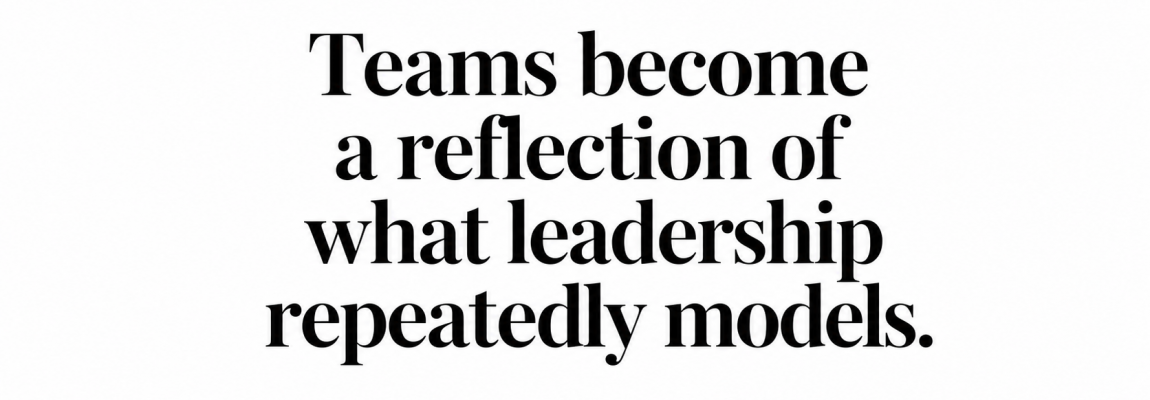
Because over time, teams tend to become a reflection of what leadership repeatedly demonstrates.
If leaders want to change culture, the most effective place to start is not with words. It is with behaviour.
And when behaviour changes consistently, culture eventually follows.