Why the Best Leaders Don’t Need to Know Everything
One of the earliest lessons leadership taught me had nothing to do with strategy, performance management, or decision-making. It taught me something about myself.
When I first stepped into a leadership role, I found myself managing people who were older than me, had been in the organisation much longer, and in many cases possessed significantly greater technical expertise. On paper, I had been appointed to lead the team. In my mind, however, I felt as though I still needed to earn the right to be there.
I carried an invisible pressure that I suspect many new leaders experience but rarely talk about. I believed I had to justify the organisation’s decision to promote me. Every meeting became an opportunity to demonstrate competence. Every difficult question felt like a test. Whenever I didn’t immediately know the answer, I saw it as evidence that perhaps I wasn’t as capable as everyone thought.
Looking back, I realise I misunderstood what confidence actually looked like.
At the time, I thought confidence meant appearing certain. I believed good leaders responded quickly, had answers readily available and projected an image of complete control. It took several years, and the example of some exceptional leaders, before I understood that genuine confidence looks very different.
Why Leadership Confidence Is Often Misunderstood
Leadership often comes with expectations that are visible to everyone else. What is less visible is the pressure leaders place on themselves.
For many people, promotion brings an underlying fear of being exposed. We begin asking ourselves questions that we would never say out loud. What if people discover I don’t know enough? What if they realise someone else would have been better suited to this role?
Those questions influence behaviour in subtle ways.
We become reluctant to admit uncertainty because we mistake vulnerability for weakness. We hesitate to ask questions because we fear they might undermine our credibility. We spend more time trying to demonstrate our knowledge than developing our understanding.
Interestingly, none of this is usually driven by arrogance. More often, it is driven by insecurity.
That was certainly true in my own experience.
The desire to prove ourselves can easily become stronger than the desire to learn. Unfortunately, the moment that happens, leadership becomes performative rather than effective.
The Leaders Who Changed My Thinking
As my career progressed, I became increasingly interested in observing leaders who consistently earned the respect of those around them. Not leaders who commanded authority because of their title, but those whose influence extended well beyond the organisation chart.
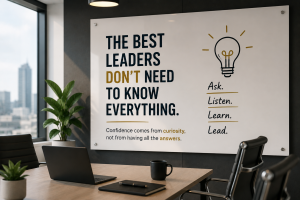
What struck me wasn’t their ability to answer every question. In fact, some of the most respected leaders I worked with were remarkably comfortable saying, “I don’t know.”
At first, I found that surprising.
Surely leaders were supposed to know.
Surely admitting uncertainty would diminish confidence.
Instead, I watched those leaders ask thoughtful questions, invite different perspectives and encourage healthy disagreement. They seemed completely untroubled when someone else possessed greater expertise than they did. Rather than feeling threatened by it, they actively drew upon it.
Gradually, I realised that they weren’t trying to demonstrate how knowledgeable they were.
They were trying to make the quality of the decision better.
That is a fundamentally different approach to leadership.
Confidence Changes the Questions We Ask
One observation has stayed with me throughout my career.
Insecure leaders often ask themselves, “How do I show people I know enough?”
Confident leaders ask a different question.
“How do we arrive at the best decision?”
The distinction may appear small, but it changes almost everything.
Once your priority becomes finding the best answer rather than being the person with the answer, the expertise around you stops feeling like competition.
It becomes one of your greatest assets.
You begin asking more questions.
You become genuinely curious about perspectives that differ from your own.
You find yourself listening to understand rather than listening to respond.
Most importantly, you create an environment where people feel safe contributing what they know instead of waiting to be told what to think.
In my experience, that is where the strongest decisions are made.
Leadership Is Not an Individual Performance
One of the biggest shifts in my own thinking came when I stopped viewing leadership as an individual demonstration of competence.
Leadership is not about proving that you are the smartest person in the room.
Nor is it about having an opinion on every subject.
It is about creating the conditions in which the collective intelligence of the room can be used effectively.
Every experienced team member brings years of accumulated judgement, technical knowledge and practical insight. A leader who feels compelled to outperform all of that knowledge limits both themselves and their team.
A leader who knows how to harness it multiplies the capability of the entire organisation.
This is one of the reasons I believe humility and confidence are far more closely connected than many people realise.
Humility keeps us open to learning.
Confidence allows us to learn without feeling diminished by it.
The strongest leaders possess both.
Why This Matters Beyond Leadership
I’ve also seen this principle play out repeatedly in business.
Some organisations invest enormous energy trying to convince clients that they have every answer. They present certainty as though certainty alone creates confidence.
The businesses that consistently earn trust tend to behave differently.
They ask thoughtful questions before recommending solutions. They are comfortable acknowledging complexity where it exists. They spend less time trying to impress clients with what they know and more time understanding what the client actually needs.
Ironically, this approach often strengthens credibility rather than weakening it.
People are generally less interested in working with someone who claims to know everything than they are in working with someone they trust to find the right answer.
Leadership works in much the same way.
The Takeaway
When I reflect on my own leadership journey, I don’t wish I had possessed more technical knowledge during those early years. Experience would have brought that in time.
What I wish I had understood sooner was that confidence is not measured by the number of answers we have.
It is measured by how secure we are when we don’t have them.
The leaders who have influenced me most were never trying to be the smartest people in the room. They were creating environments where everyone else’s expertise could flourish.
Looking back, I realise that was the confidence I had been searching for all along.
Not the confidence that comes from believing you know everything.
The confidence that comes from knowing you don’t have to.