The Bias Every High Performer Has to Manage
High-performing leaders are trained, over many years, to produce results quickly.
Fast analysis. Clear decisions. Measurable outcomes. This is what gets recognized. This is what gets rewarded.
But the habits that accelerate early-career success often become the ones that limit long-term leadership effectiveness. The instinct to solve immediately, to move fast, to measure everything in a single cycle, these instincts do not always serve the work that matters most over time.
What Long-Term Leadership Actually Requires
Long-term leadership requires a different relationship with time.
Not slower decision-making. Not less urgency. But a disciplined practice of investing in things that will not show a return in the current quarter, and doing that consistently, even when the immediate pressures are high.
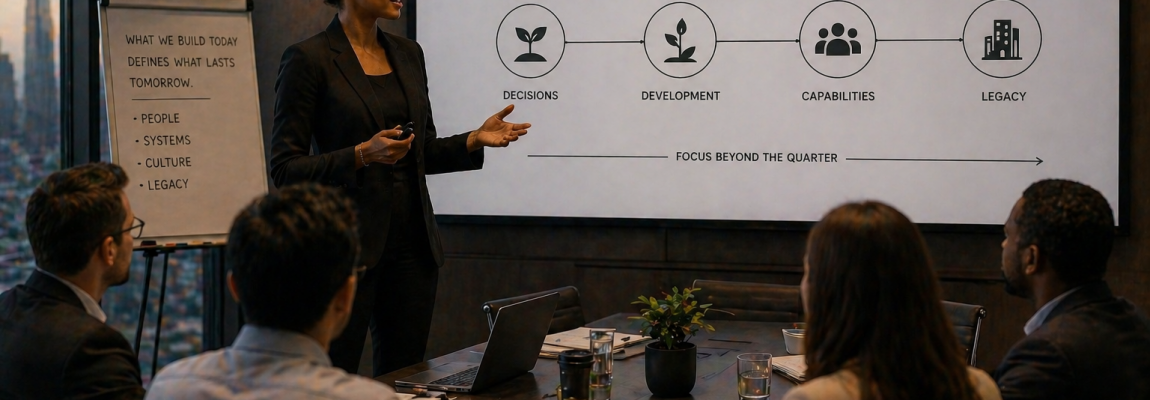
This includes developing people who will not be ready to lead for two more years. Building systems that reduce decision-making bottlenecks, the leader will not personally experience them again. Creating a culture that will outlast the leader’s tenure.
These investments are hard to make when the urgent is competing with the important.
The Short-Term Trap
Most organizational environments are not designed to reward long-term thinking.
Quarterly targets. Annual reviews. Budget cycles. These structures are necessary. But they also create a gravitational pull toward the immediate.
Leaders who do not actively resist this pull find that their attention and their team’s energy concentrate almost entirely on what needs to happen next. The strategic work, the developmental work, and the structural work get deferred.
Deferred long enough, it does not happen.
How Long-Term Leaders Think Differently
The leaders who build lasting organizations ask different questions.
Not just what is the right decision here, but what kind of decisions do we want to be making three years from now, and is this building toward that?
Not just how do we hit this target, but what capabilities do we need to build so that hitting this target becomes easier every year?
Not just how do we retain this person, but what kind of organization do we need to become so that the people we most need choose to stay?
These questions do not replace the immediate ones. They sit alongside them. And the leaders who hold both simultaneously are the ones who build organizations that last.
The Discipline of Protecting Long-Term Investment
Long-term thinking is not something that happens naturally in most leadership environments. It has to be protected.
This means being deliberate about where attention goes. It means creating time in the calendar for strategic work that has no immediate deliverable. It means rewarding team members for developmental contributions that will not show up in this quarter’s results.
It also means being honest about the difference between being busy and making progress. Many leaders are very busy doing things that do not move the organization forward in any meaningful way. The discipline is in knowing the difference and choosing accordingly.
The Takeaway
The leaders who create lasting impact are not always the ones who moved the fastest or delivered the most in any single period.
They are the ones who understood that leadership at its most consequential is always a long-term investment.
Every decision made with the next three years in mind, every person developed, every system built, these are the deposits into a future that will not be fully visible for a long time.
That is not a reason to avoid making them. It is precisely the reason they matter.