Why Ideas Alone Are Not Enough
Every meaningful organizational change begins with an idea.
A vision for how the team should operate. A direction for where the business needs to go. A sense of what is broken and what needs to shift.
But ideas alone do not create results. Many organizations remain stuck not because the vision is unclear, but because the process of turning that vision into reality is not structured well enough to support it.
Leadership is not just vision. It is execution.
The Gap Between Vision and Reality
One of the most common challenges in leadership is the gap between what is imagined and what is delivered.
At the beginning, everything feels possible. Direction feels strong. The team is aligned. Energy is high.
But as decisions begin to stack, complexity increases. People need to be aligned. Resources need to be allocated. Timelines need to be realistic. Competing priorities need to be managed.
Without structure, even the strongest vision can lose clarity. This is where most leadership initiatives slow down or quietly fall apart.
Why Structure Matters in Leadership
Turning a vision into outcomes requires more than inspiration. It requires discipline.
Clear decisions need to be made early. Priorities need to be defined. Every action needs to connect back to the original intent.
When structure is missing, leadership becomes reactive. Decisions are made based on urgency rather than direction. But when structure is present, the process becomes focused and controlled. Progress becomes consistent.
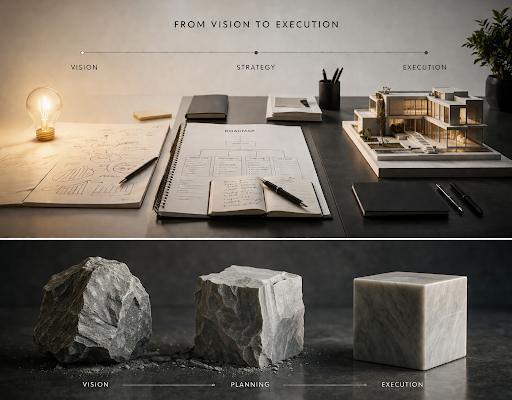
From Vision to Direction
The first stage of any successful leadership initiative is clarity.
What should the outcome look like? How will the team function differently? What matters most right now?
These questions define direction. Without clear direction, decisions become scattered. With clarity, every choice becomes easier to make.
This stage is not about action. It is about alignment. Alignment on purpose before movement begins.
From Direction to Decisions
Once the direction is clear, the next step is translating it into practical decisions.
Roles are defined to reduce ambiguity. Resources are allocated based on priority. Timelines are set with accountability in mind. Communication structures are put in place to maintain alignment.
Each decision builds on the previous one. This is where leadership shifts from abstract direction to something the team can actually act on.
Managing Complexity Without Losing Clarity
As any initiative moves forward, complexity increases naturally.
Multiple workstreams develop at once. Timelines overlap. Unexpected challenges require adjustment.
Strong leadership means staying grounded through this stage. It is easy to get pulled toward new ideas or short-term pressures. But consistency is what protects the integrity of the original direction.
Clarity must be maintained from start to finish.
Execution Is Where Leadership Is Proven
The final stage is where everything comes together.
Plans are implemented. Teams deliver. Results become visible.
This is where leadership is no longer theoretical. It becomes a lived experience for the people inside the organization. Execution is where the quality of every upstream decision becomes apparent.
When the process has been intentional, the result feels coherent, sustained, and earned.
The Role of Detail in the Final Outcome
It is often the smallest decisions that determine the quality of an outcome.
How a difficult message is communicated. How a setback is handled in real time. How accountability is maintained when the pressure is high.
These moments are not always visible. But they shape how the work is experienced and how the team is built over time.
Attention to detail is what separates a completed initiative from a truly effective one.
The Takeaway
Great leadership is not about having a strong idea.
It is about guiding that idea through a clear, structured process until it becomes something real and repeatable.
From vision to execution, every decision matters. And when those decisions are made with intention and discipline, the result is not just a completed project. It is an organization that works better, lasts longer, and knows how to do it again.